Why is boat speed measured in knots?
Ask a sailor how fast the boat is going and the answer will never be in kilometres per hour. It will be in knots. On a powerboat or sailing course in the Algarve you'll quickly get used to it, but the origin of the word is one of the nicest curiosities of navigation.
What is a knot?
A knot is a unit of speed: one nautical mile per hour. The international nautical mile measures exactly 1,852 metres, so 1 knot is 1.852 km/h. A sailing yacht doing 6 knots is moving at about 11 km/h; a RIB planing at 25 knots is doing about 46 km/h.
A small detail that experienced sailors notice: since a knot is already "per hour", saying "knots per hour" is wrong. You simply say the boat is making 6 knots.
Why the nautical mile?
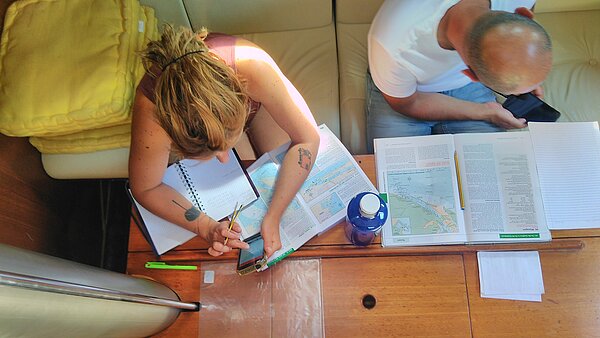
The nautical mile is linked to the shape of the Earth. Traditionally, one nautical mile corresponds to one minute of latitude. This makes life much easier on a chart: the latitude scale on the side of the chart is also a distance scale. If you move one degree of latitude north, you have travelled 60 nautical miles. This is exactly the kind of practical trick you learn in the chartwork part of a course.
The chip log: a rope with knots
For centuries, ships had no GPS or electronic log. To measure speed, sailors used a chip log: a small wooden board, shaped like a quarter circle and weighted so it stayed upright in the water, tied to a long line wound on a reel.
The board was thrown over the stern. Because it stayed more or less still in the water, the line ran out as the ship moved ahead. Along the line there were knots tied at regular intervals. A sailor turned a small sandglass, usually of 28 seconds, and counted how many knots slipped through his fingers before the sand ran out. That number was the ship's speed.
Why 28 seconds and 47 feet?
The trick was in the maths. The knots were tied about 14.4 metres (47 feet 3 inches) apart. 14.4 metres in 28 seconds is exactly the same proportion as 1,852 metres in one hour. So each knot that passed in 28 seconds meant one nautical mile per hour. Simple, clever and good enough to cross oceans.
The speed was then written in the log book, together with the course steered, and used for dead reckoning: working out the ship's position from speed, time and direction. The word "log book" itself comes from this chip log.
Knots today
Today speed comes from GPS or an electronic log, but the unit has stayed. Knots are used at sea and in aviation all over the world, and wind speed in weather forecasts for sailors is also given in knots. Learning to think in knots and nautical miles is essential for planning a passage, calculating times of arrival and reading the forecast before going out.
Practise it on the water
On our courses in Faro you'll put this into practice: reading speed and distance, planning a short passage on the chart and checking it against what really happens on the Ria Formosa and along the Algarve coast.
Find out more about the MCA / IYT Small Powerboat & RIB Master course or, if you prefer sails, the IYT International Crew sailing course.