Port and Starboard: Why Sailors Don't Say Left and Right – A Sailing Course Algarve Curiosity
Port and starboard: your first words on board
On the first morning of any sailing course in the Algarve, two words come up before the lines are even cast off: port and starboard. Looking forward from the stern (the back) to the bow (the front), port is the left-hand side of the boat and starboard is the right. Simple enough — so why not just say left and right?
The answer is safety. Left and right depend on which way you are facing. If the skipper is at the helm looking forward and a crew member is on the foredeck looking aft, one person's left is the other's right. Port and starboard always refer to the boat, never to the person speaking. When you are manoeuvring in the channel off Faro with wind and tide, there is no room for confusion.
A steering oar and a right-handed helmsman
The story begins long before the modern rudder. Northern European ships were steered with a large oar fixed over the right-hand side — because most people are right-handed. In Old English that side was the steorbord, from steor (steer) and bord (side of a ship). That is where "starboard" comes from.
The helmsman holding the steering oar had his back to the other side, so the Old English called it bæcbord and the Dutch bakboord: the "back side". French turned the pair into tribord and bâbord, and Portuguese borrowed them from French as estibordo and bombordo — the words you will hear from Portuguese sailors in the Ria Formosa.
From larboard to port
For centuries, English sailors called the left side larboard, from the Middle English ladebord, the side where cargo was loaded. The trouble was obvious: shouted into a gale, larboard and starboard sound almost the same. Because ships came alongside the quay on that side, it was also known as the port side. In 1844 the British Admiralty made "port" the official term in the Royal Navy, "in order to prevent mistakes"; the US Navy followed in 1846.
Red and green: navigation lights
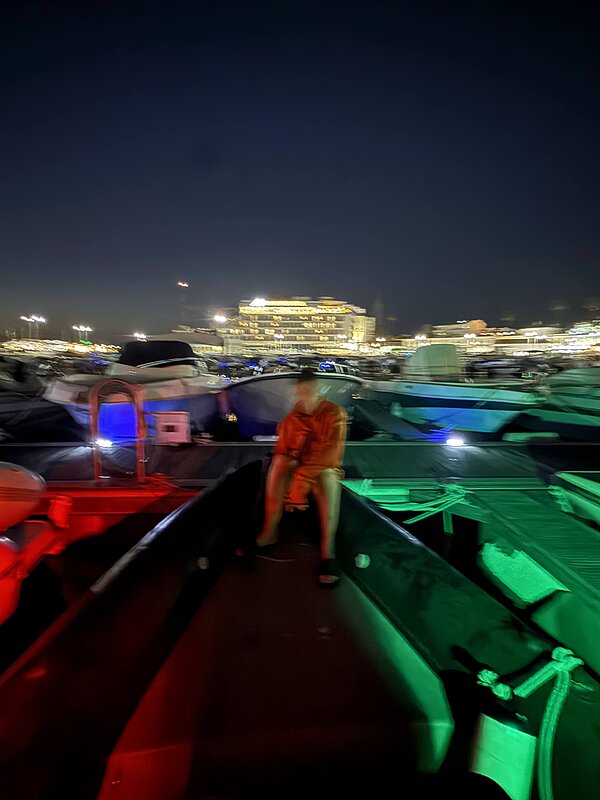
Each side also has a colour. Under the International Regulations for Preventing Collisions at Sea (COLREGs, Rule 21), sidelights are green on the starboard side and red on the port side, each shining over an arc of 112.5°, from right ahead to 22.5° abaft the beam. At night, if you can see another vessel's red light, you are looking at her port side.
The classic memory aid has a Portuguese twist: "port wine is red". Port, the left side, shows the red light — and the Algarve is a fine place to remember it.
Tacks and right of way: when the side decides who gives way
Under sail, port and starboard also decide who has right of way. COLREGs Rule 12 says that when two sailing vessels have the wind on different sides, the one with the wind on her port side (on port tack) keeps out of the way of the other. When both have the wind on the same side, the windward boat gives way. It is one of the first rules you put into practice in the Ria Formosa, where sailing yachts, fishing boats and tour boats share the channels.
Learn the language of the sea in Faro
Port and starboard are only the beginning: tacking, gybing, windward, leeward, close-hauled. On the IYT International Crew course in Faro, you learn this vocabulary hands-on, on board, with certified instructors and the Ria Formosa as your classroom. It is the natural first step towards an IYT skipper certificate. Discover the IYT International Crew course and upcoming dates.